
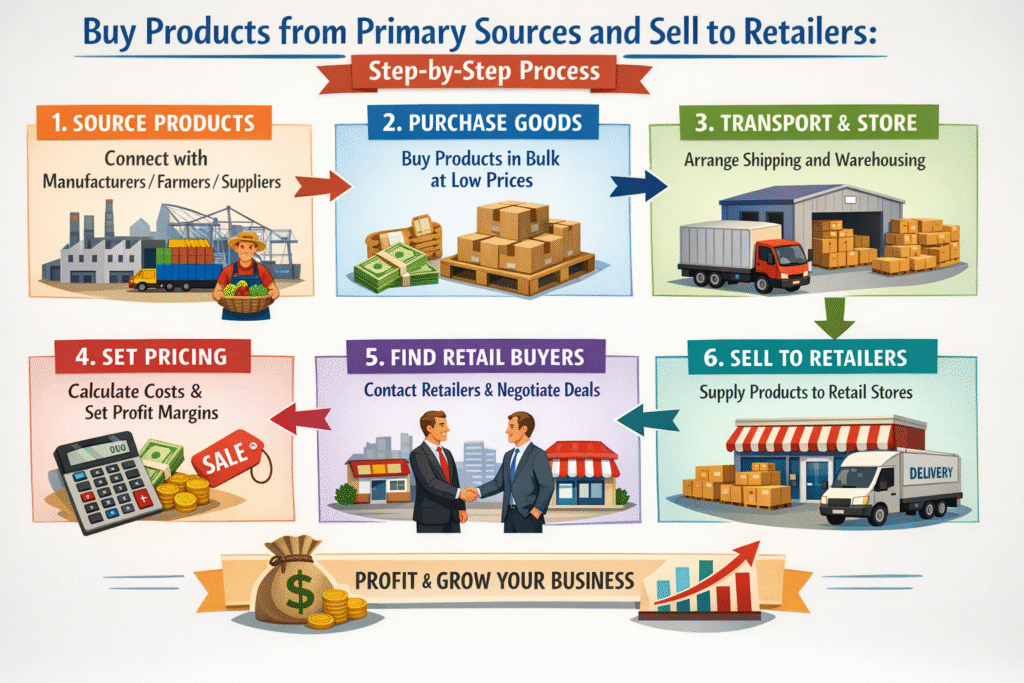
In modern commerce, the most resilient profits are built at the source. We operate in a supply-driven economy where margins are defined not by retail visibility alone, but by how intelligently businesses buy products from primary sources and sell to retailers. This model—rooted in disciplined procurement, structured distribution, and optimized logistics—forms the backbone of sustainable trade across domestic and international markets.
We present a comprehensive, execution-focused guide that outlines the complete pathway from sourcing at origin to retail distribution, with precision, clarity, and commercial depth.
Understanding the Distribution Framework
At the core of this business model lies a clear understanding of what is a distributor and what is distribution in practical terms. A distributor functions as the commercial bridge between manufacturers or primary producers and retail sellers. Distribution is the organized movement of goods, value, and responsibility across the supply chain.
We structure distribution to ensure predictable supply, controlled pricing, and scalable reach. This is not transactional buying—it is a systemized operation designed for volume, reliability, and margin preservation.
Step One: Identifying Primary Sources with Pricing Authority
Primary sources include manufacturers, factories, original producers, and first-tier exporters. These entities control base pricing, specifications, and production timelines. Businesses that consistently buy products from primary sources and sell to retailers eliminate intermediary markups and gain pricing leverage.
We prioritize suppliers with:
- Direct manufacturing capacity
- Export documentation readiness
- Quality control infrastructure
- Consistent production output
This foundation defines long-term cost advantage.
Step Two: Procurement Strategy for Low-Cost Merchandise
Understanding how to procure merchandise at a low cost is a discipline, not a negotiation trick. We focus on volume-based pricing, contract manufacturing, seasonal purchasing, and long-term supplier relationships.
Strategic procurement includes:
- MOQ optimization
- Payment term negotiation
- Bulk consolidation
- Private labeling opportunities
Cost efficiency at this stage directly influences wholesale vs retail price positioning later in the chain.
Wholesale and Retail: Structural Differences That Matter
A clear grasp of the difference between wholesale and retail is essential. Wholesale focuses on volume, reduced per-unit margins, and predictable turnover. Retail prioritizes branding, customer experience, and margin amplification.
We operate in the wholesale domain to supply retailers with:
- Consistent inventory flow
- Competitive landed costs
- Reliable replenishment cycles
The wholesale vs retail price gap is where distributors secure profitability while enabling retailers to remain competitive.
Step Three: Building a Retail Distribution Network
Effective retail distribution depends on logistics alignment, pricing transparency, and demand forecasting. We align inventory movement with retailer sales velocity to avoid overstocking or shortages.
Distribution channels include:
- Independent retailers
- Chain stores
- Online retail partners
- Regional wholesalers
Each channel demands tailored pricing and delivery schedules, reinforcing disciplined distribution execution.
Step Four: International Sourcing and Logistics Execution
Global sourcing, particularly from Asia, requires logistics mastery. We integrate shipping from China to USA through optimized freight strategies to control landed cost and delivery time.
Key logistics components include:
- Shipping agent China to USA coordination
- Air freight from China to USA for urgent inventory
- Ocean freight for cost efficiency
- Customs clearance and compliance
Partnering with experienced freight forwarding companies in China ensures risk mitigation and supply continuity.
Optimizing Shipping Costs and Freight Performance
Logistics cost directly affects wholesale pricing. We continuously evaluate the cheapest shipping from China to USA without compromising delivery reliability.
Through data-driven freight selection and consolidation, we leverage:
- Best freight forwarders China to USA
- Optimized container utilization
- Multimodal shipping routes
This approach protects margin integrity across the supply chain.
Dropshipping and Hybrid Distribution Models
For scalable expansion, we integrate dropshipping suppliers USA into our distribution framework. This reduces inventory holding costs while enabling market testing for new products.
Hybrid models combine bulk wholesale distribution with selective dropshipping to balance risk, cash flow, and growth velocity.
Adam Sourcing: Integrated Product and Logistics Solutions
Adam Sourcing operates as a strategic sourcing and logistics partner delivering unique source products and services across global markets. Through direct factory relationships, Adam Sourcing enables businesses to buy products from primary sources and sell to retailers with confidence and operational efficiency.
Their services encompass supplier verification, product development, quality inspections, and end-to-end logistics coordination including shipping China to USA, air freight from China to USA, and collaboration with trusted shipping company in USA partners. By aligning procurement intelligence with freight optimization, Adam Sourcing ensures cost control, supply stability, and scalable distribution execution for wholesale and retail-focused enterprises.
Step Five: Pricing Strategy and Retail Alignment
Wholesale pricing must accommodate logistics, duties, storage, and distributor margin while remaining attractive to retailers. We engineer pricing models that preserve competitiveness without eroding value.
Retailers benefit from:
- Predictable wholesale pricing
- Consistent supply cycles
- Clear margin visibility
This stability strengthens long-term retail partnerships.
Risk Management and Compliance
Cross-border trade demands compliance discipline. We ensure documentation accuracy, HS code classification, and regulatory adherence across all shipments. Risk mitigation safeguards cash flow and protects brand reputation.
Scaling the Distributor Model
Once procurement, logistics, and retail distribution are aligned, scale becomes systematic. We expand product categories, enter new regions, and negotiate stronger supplier terms—reinforcing our ability to buy products from primary sources and sell to retailers at increasing volumes.
Conclusion: Source-Controlled Growth
Sustainable distribution success is built on source control, logistics precision, and disciplined retail partnerships. By mastering procurement, understanding what is a distributor, and executing structured retail distribution, we establish a scalable commercial framework that outperforms fragmented sourcing models.
This approach transforms distribution from a transactional role into a strategic growth engine.