
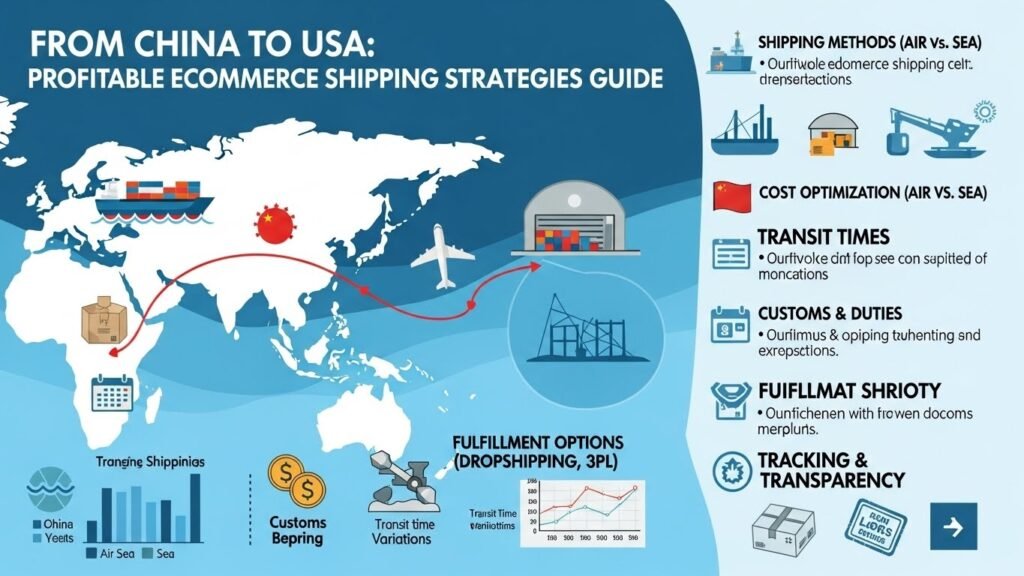
The Modern eCommerce Landscape Between China and the USA
We operate in an era where Ecommerce is no longer an option but the structural backbone of global retail. The commercial corridor between China and the United States represents the most lucrative artery in international online trade, enabling brands to scale faster, diversify product lines, and unlock competitive pricing. Understanding what is ecommerce today means recognizing it as a data-driven, logistics-powered, and platform-centric ecosystem that connects manufacturers, sellers, and consumers in real time.
An advanced ecommerce platform now integrates sourcing intelligence, inventory visibility, and logistics automation, making cross-border trade from China to the USA operationally seamless. However, profitability hinges on mastering shipping strategy—where margins are either protected or destroyed.
Product Discovery and Data-Driven Sourcing at Scale
Sustainable growth begins with intelligent product discovery ecommerce models that align demand signals with manufacturing capability. We rely on structured ecommerce product data to identify market gaps, evaluate supplier performance, and forecast shipping costs with precision. This data-centric approach enables us to recommend high-conversion ecommerce product recommendations rather than relying on speculative sourcing.
China’s manufacturing depth allows rapid deployment of ecommerce products across categories such as consumer electronics, home goods, automotive components, and fashion. When aligned with US demand trends, these pipelines generate consistent access to trending ecommerce products while maintaining cost control.
Strategic sourcing partners such as Adam Sourcing play a critical role in bridging quality assurance, compliance, and supplier negotiation, ensuring products move from factory to fulfillment without friction.
Shipping Infrastructure That Protects Margins
Profitability in cross-border Ecommerce is tightly linked to shipping architecture. Selecting the correct shipping china to usa framework determines delivery speed, landed cost, and customer satisfaction. We engineer shipping routes by balancing air, sea, and hybrid models based on SKU velocity and margin sensitivity.
High-value or time-sensitive products benefit from air freight from china to usa, while bulk inventory relies on consolidated sea freight. Partnering with a reliable shipping agent china to usa enables customs optimization, documentation accuracy, and predictable transit timelines.
Working with vetted freight forwarding companies in china gives us leverage in carrier negotiation and container optimization, a decisive advantage when aiming for the cheapest shipping from china to usa without sacrificing reliability.
Fulfillment Models That Scale with Demand
Understanding how ecommerce product fulfillment works is fundamental to scaling profitably. We deploy adaptive fulfillment frameworks that respond dynamically to order volume, geography, and inventory flow. Whether centralized or distributed, modern ecommerce fulfillment for online sellers must integrate seamlessly with storefronts and marketplaces.
We evaluate every SKU against the best fulfillment method for ecommerce, mapping cost-to-serve against delivery expectations. Our ecommerce fulfillment step by step approach ensures inbound inspection, real-time inventory sync, pick-and-pack automation, and last-mile optimization.
The decision between professional fulfillment vs self fulfillment is resolved through data. As order velocity increases, scalable ecommerce fulfillment solutions outperform in-house models by reducing fixed costs and operational risk.
Logistics as a Competitive Advantage
Advanced ecommerce logistics solutions transform shipping from a cost center into a growth lever. We design logistics flows that integrate bonded warehousing, regional distribution centers, and predictive demand planning. These systems enable faster delivery times and lower returns, reinforcing brand trust.
Our strategy leverages best ecommerce shipping solutions that align carrier selection, customs brokerage, and fulfillment software into a single operational layer. By adopting cloud ecommerce solutions, we gain real-time visibility into shipments, costs, and performance metrics.
For large brands, enterprise ecommerce solutions provide multi-warehouse orchestration and cross-channel inventory control, while niche verticals benefit from specialized frameworks such as automotive ecommerce solutions, where compliance and handling standards are non-negotiable.
Dropshipping and Hybrid Distribution Models
Dropshipping remains a viable entry strategy when paired with verified dropshipping suppliers usa and strict quality controls. However, long-term profitability often emerges from hybrid models that combine dropshipping with bulk imports and domestic fulfillment.
We structure hybrid networks that source from China while positioning inventory strategically within the US, reducing delivery time and enhancing customer experience. This model is particularly effective when guided by partners like Adam Sourcing, who align supplier reliability with logistics execution.
The Role of Strategic Partners in Cross-Border Success
Cross-border Ecommerce demands coordination across sourcing, logistics, compliance, and marketing. Collaborating with a trusted shipping company in usa ensures last-mile consistency, while a seasoned shipping agent china to usa mitigates regulatory risk and transit volatility.
Our ecosystem includes best freight forwarders china to usa who provide consolidated shipping, rate transparency, and contingency planning during peak seasons. These partnerships safeguard margins when freight markets fluctuate.
Marketing, Platforms, and Brand Acceleration
A robust shipping strategy amplifies the effectiveness of marketing. When delivery promises are reliable, conversion rates rise across marketplaces and DTC channels. We collaborate with performance-focused teams, including an ecommerce marketing agency, to align logistics capabilities with promotional campaigns.
Modern brands leverage ecommerce accelerator solutions to compress time-to-market, integrating logistics, payments, and analytics into a single growth engine. Meanwhile, custom ecommerce solutions enable differentiated customer experiences tailored to niche audiences.
For flexibility and scalability, ecommerce cloud solutions support rapid expansion without infrastructure bottlenecks, while custom ecommerce solution architectures allow brands to adapt shipping logic based on geography and demand patterns.
Platform Evolution and Industry Context
Global brands demonstrate the maturity of Ecommerce as a model. Questions like Is Zara an eCommerce? reflect how omnichannel giants integrate digital commerce as a core revenue stream. Similarly, understanding What are the 4 types of e-commerce?—B2C, B2B, C2C, and C2B—helps contextualize shipping strategies within broader market structures.
Each model demands a tailored logistics approach, particularly when navigating international supply chains between China and the USA.
Future-Proofing Profit Through Intelligent Shipping
Profit growth in Ecommerce is no longer driven solely by product pricing. It is engineered through shipping intelligence, fulfillment agility, and data-driven decision-making. By aligning sourcing, logistics, and platform strategy, we create resilient systems that withstand market volatility.
The integration of sourcing expertise, such as that provided by Adam Sourcing, with advanced logistics and fulfillment frameworks ensures consistent quality, predictable costs, and scalable growth. When executed with precision, shipping becomes a strategic asset rather than a constraint.